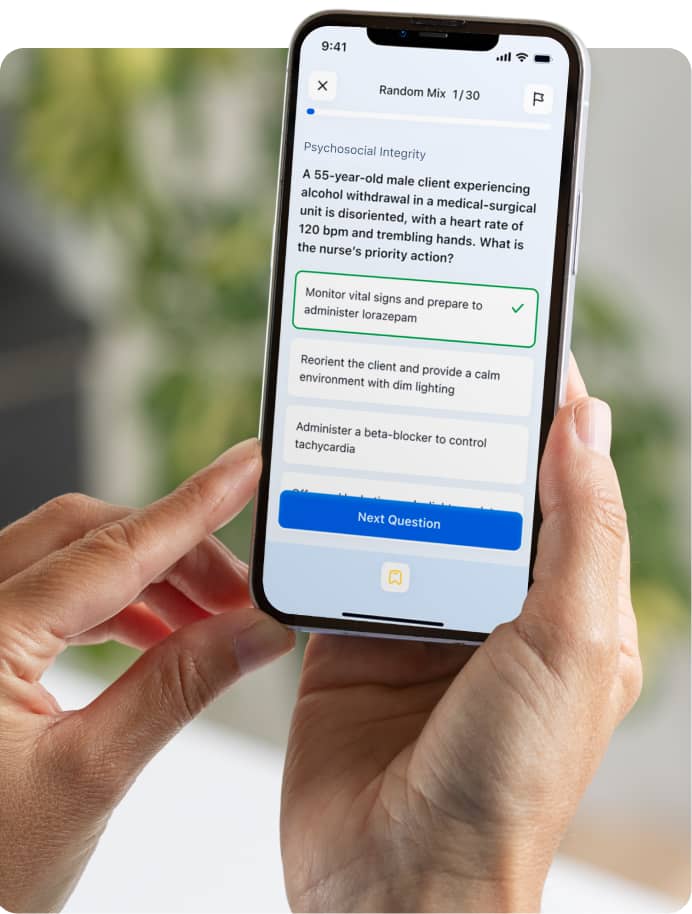
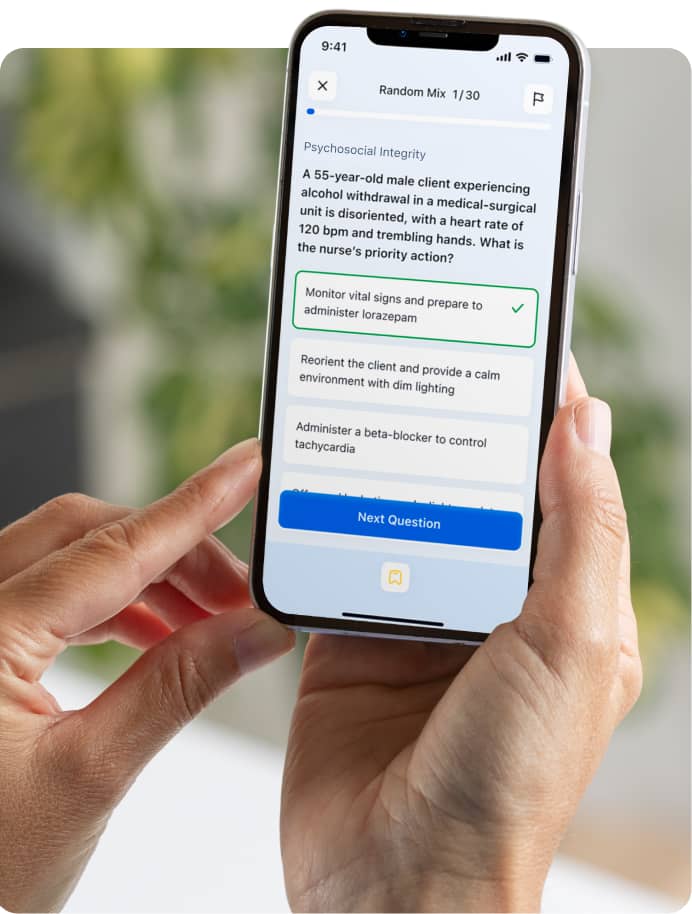
What Is the NCLEX-RN® Exam?
The NCLEX-RN® (National Council Licensure Examination for Registered Nurses) is a computerized adaptive test that determines whether nursing graduates are prepared for safe, entry-level nursing practice. Unlike nursing school exams that primarily test recall and recognition of facts, NCLEX-RN® tests clinical reasoning and application.
Instead of asking "What is the normal potassium range?", the NCLEX-RN® presents a patient scenario requiring you to recognize hypokalemia, understand its relationship to digoxin toxicity, and determine the priority nursing action. This fundamental difference means your study approach must shift from pure memorization to practicing clinical decision-making.
How CAT Scoring Works
The exam adapts to you. After each answer, the computer re-estimates your ability from all your answers so far and the difficulty of those items, then picks the next item from the test plan content area your exam needs, at a difficulty you should have around a 50% chance of answering correctly. So every candidate should find the items challenging, and NCSBN notes that candidates cannot reliably tell which items are easy and which are difficult. The NCLEX-RN® uses a logit scale where the passing standard stays constant while question difficulty varies. Once you have answered the minimum number of items, the exam ends when the computer is 95% certain that your ability is clearly above or below the standard, which is why some candidates finish at 85 questions and others continue to 150.
85 questions — computer reached a confident decision quickly, could be a clear pass or clear fail.
86–149 questions — computer needed additional data points to determine your ability level.
150 questions — maximum length reached. The computer decides from your final ability estimate, based on your responses to all items in the exam.
Next Generation NCLEX® (NGN)
Since April 1, 2023, the NCLEX-RN® has included NGN items, built to better measure clinical judgment. They follow the NCSBN Clinical Judgment Measurement Model (NCJMM) and its six steps: Recognize Cues, Analyze Cues, Prioritize Hypotheses, Generate Solutions, Take Action and Evaluate Outcomes. Every exam includes three case studies of six items, one item per step, and clinical judgment is also measured with stand-alone items.
NCSBN's Candidate Tutorial shows the item formats: multiple choice, multiple response (select all that apply, select N and grouping), matrix, drop-down, highlight, bow-tie and fill-in-the-blank calculation. Any item can include charts, tables and graphics, and items can come with exhibit tabs.
Items with more than one correct answer earn partial credit under one of three NCSBN methods. Under plus/minus, incorrect selections cost points, but an item never scores below zero; under zero/one, correct responses earn points and incorrect ones earn none; under rationale scoring, both parts of a pair must be correct. For each format, see our NCLEX question types guide.
NCLEX-RN® Results & Scoring
There are no numerical scores on the NCLEX-RN® — the only results possible are Pass or Fail. You will receive your official results from your state Board of Nursing within six weeks after taking the exam. If your state participates in the Quick Results Service, you can access your unofficial results two business days after testing for a small fee. See how and when NCLEX results arrive.
Retaking the NCLEX-RN®
If you don't pass, you can retake the exam: up to eight times a year, with at least 45 test-free days between attempts, if you applied for licensure with a participating nursing regulatory body (NRB); some NRBs require a longer wait or set stricter limits. You'll need to re-register and pay the exam fee again for the NCLEX-RN®. Read the full NCLEX retake policy.